Maya Newell’s Indigenous doc resonates with festivals, commercial audiences

24 February, 2020 by Don Groves in Inside Film

Maya Newell’s feature documentary In My Blood It Runs has been winning hearts and minds since the world premiere in competition at Hot Docs Canadian International Documentary Festival last year.

The biopic of 10-year-old Dujuan Hoosan, a child healer and hunter in the Northern Territory who was struggling at school and facing increasing scrutiny from welfare and the police, is resonating with both festival and commercial audiences.

Developed via GoodPitch Australia, the film grossed an impressive $127,000 from the Sydney, Melbourne, Darwin, Brisbane, CinefestOZ and Screenwave film festivals and, earlier this month, the Perth Festival.

Co-distributed by Jonathan Page’s Bonsai Films and the filmmakers, the doc launched on six screens in the capital cities last Thursday, sold out multiple Q&A sessions and rang up $55,000.

It was among the top titles at Cinema Nova, where CEO Kristian Connelly observes: “In My Blood It Runs surpassed all expectations, selling out three Q&As in Carlton as well as multiple shows across the weekend. We added extra sessions to meet demand.”

Page says the film will continue at all six cinemas, he is adding several locations and it will then roll out out across the rest of the country via FanForce.

Citing successes such as The Australian Dream and Dark Emu, Page says: “I think Indigenous stories and issues are front and centre these days.

“The filmmakers have been exceptional at building audiences, working with committed partners and supporters from day one and then activating the audience well in advance of the release. The number of sessions selling out before the release was remarkable.”

The Q&As have been shared among the producers, Closer Productions’ Sophie Hyde, Rachel Naninaaq Edwardson, Larrissa Behrendt and Newell.

Last week Newell spoke at a screening at the Alice Springs town camp where the opening scenes were filmed. “People were very teary and moved at the end,” she tells IF.

With the help of social impact teams and the organisations Akeyulerrre and Children’s Ground, the film champions the creation of a First Nations-led education system and an end to incarcerating Indigenous kids.

“We always wanted to use the cinema release as an opportunity to light a spark on the incredible work of the First Nations peoples and organisations that have been pushing for educational reform for a very long time,” she says.

“This boy Dujuan, who was not on anyone’s radar and the least likely to be listened to, was the youngest person to address the UN Human Rights Council last September.

“The Western systems that were meant to uplift him failed him. In the end, his family found a solution for him.”

Perhaps surprisingly, international distributors and sales agents turned down the chance to handle the doc so the filmmakers have taken that into their own hands.

Sentient.Art.Film, which released Gabrielle Brady’s Island of the Hungry Ghosts, has acquired the US rights and Newell expects to announce deals with significant international broadcasters soon.

The UK premiere will be held on March 15 at the London Human Rights Watch Film Festival; a UK deal is yet to be concluded.

There will be a screening in Canberra tomorrow hosted by Labour Senator for the Northern Territory Malarndirri Barbara Anne McCarthy, which will also see Dujuan’s grandmothers and educators present their road map for a First Nations-led education system.

In My Blood It Runs was funded by GoodPitch Australia, Documentary Australia Foundation, Screen Australia, Screen Territory and the South Australian Film Corporation.

Maya Newell: Don’t be afraid of doing things differently

Screen HubThursday 20 February, 2020 by Rochelle Siemienowicz

Shot at dusk on a street in Alice Springs, the opening scene of Maya Newell’s In My Blood it Runs is intimate and cheeky. We see an Indigenous mother looking straight into the slightly wobbly lens, answering her child’s questions about himself. The love between them – and also her concern for him – are palpable.

The 10-year-old Arrernte and Garrwa boy holding the camera is Dujuan Hoosan. Both he and his mother, Megan Hoosan, are credited as ‘collaborating directors’ of an observational documentary that was made with a clear social purpose. Turning these subjects into active credited participants in the filmmaking process is just one example of the film’s deep collaborative and consultative approach. Other members of Dujuan’s family and community are also named as collaborating directors and advisors in a project that sets a gold standard for non Indigenous creatives working with Indigenous stories, as well as for documentaries wishing to impact policy and create wider social change.

A different way of working with Indigenous communities

The philosophy and protocols behind the film are outlined as an Indigenous Project Approach [PDF] available on the film’s website for other filmmakers to use. Newell says the development and articulation of these principles owes much to the input of the producers: Rachel Naninaaq Edwardson, an acclaimed Iñupiaq/Norwegian/Sami filmmaker; Sophie Hyde, of Closer Productions, a company well known for its groundbreaking methodology (52 Tuesdays); and Larissa Behrendt, an Aboriginal Australian legal academic, writer and documentary filmmaker (After the Apology).

The key tenets of the radical approach include: partnership with those represented; having a senior Indigenous advisory team; shared profit and ownership; an ongoing duty of care; long production timelines; and strong impact strategy and messaging for distribution and exhibition.

‘We made this film in a really unique way,’ explains Newell on the phone to Screenhub from Alice Springs on the morning of the film’s outdoor premiere in the hills of the Hidden Valley Town Camp, where some key opening scenes were shot. ‘We were led by one of our producers, Rachel Naninaaq Edwardson, who brought incredible consultation models to the project. This meant that we were sitting with the family before we started filming, and throughout the whole shooting and rough cuts and fine cut process. They were able to watch footage and talk about what they did want and what they didn’t want in the film, and they knew they could pull out at any time.’

This sounds like a nightmare for control freaks and filmmakers on tight timelines, but Newell says, ‘It was very important that this was a story where the agency and creative control sat with the family and the filmmakers in collaboration.’ What this meant in practice was that, ‘we were showing footage directly after it happened and engaging in conversations about what it would mean locally and nationally, to have that story out there. This meant that there were no surprises by the time we came to the edit, and there was always a strength-based reason for including anything tricky.or sensitive.’

As for whether subjects could pull out at any time, Newell says that is something that should always be on the table. ‘It’s always a risk and I would hope that all documentary makers would take than on as part of the gig.’

Clearly this process took took a vast investment of time and energy. Not just the three years of actual filming, but the many years before that when Newell was engaged with Alice Springs communities making short films with and for them, a process that built trust and rapport. Newell says her commitment will probably include a lifelong responsibility and duty of care long after the film is archived and forgotten.

‘It’s the only way. It does take a lot of work,’ she says, ‘and a lot of the systems in the film industry and the funding bodies don’t often allow for it, but it was very important for us to represent the communities properly, and Sophie Hyde and Closer Productions were a key part of allowing us to do that and creating space from deadlines.’

Representing and Advocating for Children

Newell met Hyde at a Q&A screening of her previous documentary feature, Gaby Baby (2015). Hyde was moderating the session, and the two filmmakers hit it off immediately, both sharing the fact of being children of gay families. Representing children of those communities with sensitivity and accuracy was a key impetus for Gaby Baby, which became part of the national conversation leading to the legalisation of gay marriage.

Now, In My Blood it Runs looks set to become part of the push towards raising the minimum age of incarceration of Australian children from 10 to 14, and also the transformation of the education system for Indigenous kids. Dujuan, the boy at the heart of the film, at 12 years old was the youngest speaker to address the United Nations Human Rights Commission about the issue of child incarceration. Right now, aged 14, he’s on his way to accompany the film to Canberra, where it’s being screened to politicians on both sides of the fence. Being part of the documentary has no doubt changed his life and chances.

In a shocking statistic shown in the documentary, 100 per cent of the children incarcerated in the Northern Territory at the time of filming were Indigenous, with some as young as 10. Dujuan narrowly escapes this fate, thanks mainly to his proactive family sending him back to country, where we see him fishing, swimming, hunting and bonding with his father.

‘In every other western country the age of legal incarceration is 14,’ says Newell. ‘That’s the international human rights standard. And when we screen it in Parliament and around the country, we want people to see that resources should be put into Indigenous housing and upstream models of education instead of putting it into the justice system.’

In some excruciating and eye-opening scenes in the film we see Dujuan in the classroom, with various teachers failing to keep his attention. He plays pranks and runs away from school, an unsurprising fact given that the material he’s taught is either completely irrelevant to his day to day life, or outright disrespectful to a history of First Nations dispossession.

Newell says there is incredible work being done by teachers across the territory, and she never wanted to criticise individual teachers or schools, but wants to change the system at large. ‘I come from a family of teachers and I’d love to be making a film about how tricky it is to be a teacher working in this space without the support that they should be getting on a systems level to be teaching in a culturally safe way.’ What she hopes is that, ‘people watching the film can see beyond individual teachers or schools and see this as a systems issue, with how we talk about history in this country, and also how the education system could be adjusted for schools and teachers to be able to do their job better.’

Australia lags about 30 years behind other many countries in its First Nations led education, according to Newell, who cites New Zealand, Hawaii, some parts of Canada and the US as examples of places doing it better. Indigenous kids here, she says, ‘just want what other children in Australia have which is to have their first culture taught and prioritised in their education.’

Supporting the film with Impact Strategies

Asked whether she always intended to make documentaries with social effect, Newell says, ‘I think most documentary filmmakers are attracted to the form because there’s an opportunity for social change through story.’

The job of impact producer barely existed five years ago, and now it’s a key role on any documentary with purpose. It wasn’t until Newell was introduced to the Good Pitch model in 2016 with Shark Island and Documentary Australia Foundation, that she realised, ‘Not only could you make the film, but you could also support it with impact strategies.’ She credits ‘the amazing contribution of Alex Kelly, our impact producer, who has worked on campaigns like Ngapartji Ngapartji, where they achieved an Indigenous language policy in Canberra. Having that thought leadership on our own impact campaign was very important.’

Read more: Hire an impact producer, change the world

With impact partners that include Amnesty International, the Australian Human Rights Commission and World Vision, the ‘Change Goals’ for In My Blood It Runs are set out clearly on its website, with clear calls to action for interested viewers. This is the world of documentaries that set their sights further than festival screenings and awards. On a clearly pragmatic level, it’s a key way to build audiences and extend the life of a film project.

Asked for any final advice for young filmmakers, Newell says: ‘The most important thing is to trust your intuition and your moral code of ethics when you’re making documentaries. Don’t be afraid of doing things differently from the way the status quo tells us to do them.’

For her thoughts on the big issues facing Australia’s documentary filmmakers, here’s a great little interview with Screen Australia:

In My Blood It Runs is in national release from 20 February 2020.

The Saturday Paper profile – Alex Kelly

A conversation with film and theatre producer Alex Kelly about making the documentaries Island of Hungry Ghosts and In My Blood It Runs, and working with Naomi Klein on This Changes Everything. By Kirsten Krauth.

Alex Kelly is 34 weeks pregnant, reclining on a small stage the shape of a four-poster bed. As we speak, the lights dim and glare, and she directs ambient mist that surrounds us in sound and smoke. She’s in pre-production for a new show she’s created, The Things We Did Next, a play set in 2029, when “climate impacts are a daily reality”. Through the play’s format of a chat show, in which writers and thinkers “[improvise] a future version of themselves”, she hopes to “move beyond the binary of dystopia and utopia”.

Kelly’s lifelong involvement in social movements began when she discovered zines – on feminism, politics or alternative music – as a teenager. Growing up on a sheep farm with a mother heavily involved in the union movement, she felt a sense of isolation, but she says zines “opened up a world of, ‘Oh, there are heaps of other people that think like me.’ Experiences of solidarity, collectivity and community felt very deeply enriching and I’ve always gravitated to that since. I find an enormous amount of richness in being in the world in that way.”

After working extensively with Indigenous communities in Alice Springs on projects for Big hART, she received a Churchill Fellowship to research other practitioners exploring the space between art, story and campaigning. She discovered a new field, impact-producing, which involved “mapping campaign strategy across film distribution”: how a film goes into the world, who the audiences are and what producers would like those audiences to do after they’ve seen the film. The fellowship led her to work closely with Naomi Klein on This Changes Everything.

While Klein wrote a book, her partner, Avi Lewis, directed a documentary by the same name, its release culminating in the 2015 United Nations Climate Change Conference in Paris. “That project had a very clear core value, that books and films don’t change the world, social movements do,” Kelly says. “The thesis of that project was that climate change is … an economic problem and we don’t all have to drop everything [to] become climate activists.” It became about transforming every sector – immigration, education, health, agriculture – and banding together as a coalition. She went to 12 countries with Klein, “trying to bring people together across different social movements to talk about how they could build power”.

Two documentaries that Kelly has produced recently are intensely moving and poetic accounts. Island of the Hungry Ghosts uncovers the experience of asylum seekers and those who work with them on Christmas Island, while In My Blood It Runs centres on a 10-year-old Arrernte/Garrwa boy, Dujuan, negotiating his local culture alongside that imposed on him at school. When I ask Kelly what draws her to projects, she says she looks for “the intersection between ‘let’s think strategically about messages’ [and] engaging the heart by telling a story and inviting [viewers] into a world that they may not see”. She adds, “You can’t work backwards and say we’re going to make a film to make people feel x; you have to make a film that is still its own piece of art and follows the poetry of what emerges.”

For In My Blood It Runs, along with a festival and cinema release, Kelly and her team are organising screenings to the Attorney-General’s Department in Canberra, the UN in Geneva, the Northern Territory Parliament and state education ministers, “to highlight the importance of First Nations-led education”. But broader issues are also at stake, such as raising the age of criminal responsibility – currently 10 – across Australia. “If you’re 11 and you commit a crime, you go into the justice system and you could end up in Don Dale, whereas in most countries it’s 14, or even 16,” she says. “If you commit a crime before that age [overseas] then you would receive a greater level of support to address why you might have committed a crime. Australia doesn’t have that safety net for young people.” For Dujuan and his family, credited as collaborating directors on the documentary, changing this legislation was a key component of what they “wanted the film to do in the world”.

The Things We Did Next is in its early stages but is propelled by all the threads running through Kelly’s work in documentary film and impact-producing. While distribution and content matter, Kelly is always thinking ahead to what the audience will do after they’ve watched her films. And for her next move? She’s interested in the possibilities for cultural and narrative shifts. “When I think about climate change … I’m more interested in thinking about how we look after each other as the storms get worse.”

This article was first published in the print edition of The Saturday Paper on Aug 10, 2019 as “Activist listening”. Subscribe here.

Kirsten Krauth 
is a writer and editor. Her novel Almost a Mirror, shortlisted for the Penguin Literary Prize, will be published by Transit Lounge in 2020.

SHARE

Dumbo Feather – How Systems Marginalise

Director Maya Newell reveals the systemic barriers she encountered in trying to get the Indigenous cast of her latest film, In My Blood It Runs, to the world premiere in Toronto.

It’s Friday morning and I’m on a plane bound for the Hot Docs International Film Festival in Toronto for the world premiere of a new documentary I collaboratively directed, In My Blood it Runs. Shot over two years in the Northern Territory, the film shares the story of Dujuan, a 10-year-old Arrernte/ Garrwa boy who must navigate growing up black in Australia. Thrillingly, Dujuan, his mother Megan and five other family members are sitting beside me. For some, it’s their first flight; for all, it’s their first time overseas. They’re excited. I’m exhausted.

Trying to get everyone to Canada has been a Kafkaesque nightmare. It has reinforced just how hard it is for people facing disadvantage to navigate systems and experience opportunities in the way that most Australians take for granted. For me, travelling to North America requires a few easy clicks on a screen. For the other members of our team, compiling travel documents is an endless administrative process.

Home in Alice Springs, Megan and I set about getting her identification documents. In exchange for a stack of paperwork and $38, the NT Office of Births, Deaths and Marriages issue Megan a copy of her birth certificate. Twenty minutes in a queue at the Motor Vehicle Registry teaches us that identity requires consistent spelling, and Megan’s birth certificate was one letter short. There’s another $38 to obtain a correctly spelled birth certificate before zigzagging another snaking queue to have the ID reissued. The following day we discover that Megan’s last name is misspelled on her Medicare card and that her middle name is incorrect on her Centrelink card. Each inconsistency invalidated the rest of her ID and resulted in a banal, longwinded interaction and a new mountain of paperwork. This was the case for almost every piece of identification for the seven First Nations people travelling. With two weeks until the film’s premiere, an array of 18 incorrect identity documents lie on my kitchen table. How did so many bureaucrats assume that it didn’t matter enough to ask how to spell a person’s name?

The most important lesson I’ve learned while making this film is that family is everything. If any one of Dujuan’s family was left behind, they would question why anyone went at all. It’s this continuum of this unconditional love and mutual care that gives these families the sustenance to survive our impenetrable systems of oppression. This trip was an opportunity to support Dujuan, who would be courageously sharing his story for the first time on an international stage. Why was it so hard to get a family—with an explicit business purpose to travel—as invited guests of North America’s largest documentary festival, overseas for six days?

Over these last months, I have demanded attention to the misspelled names and developed an unapologetic register when speaking to all levels of bureaucrats. But in leveraging my privilege to solve this ludicrous administrivia, I was struck by how corrosive this process is to the collaborative dynamic we had established with the family. I was forced, again and again, into the colonial role of “saviour”—one that we, as a team, have always explicitly tried to avoid. This family are my collaborators, mentors, teachers and friends; they have led me and generously let me into their world.

In My Blood It Runs was made in collaboration with those who feature onscreen; we have shared creative decisions, resources, and have worked to ensure that the people in the film are in control of the ways in which they were represented. While not always perfect, we made a big effort to challenge conventional power dynamics. Yet my role as bureaucratic “problem solver” threw these small wins into jeopardy.

Aboriginal and Torres Strait Islander peoples’ stories should always be told with a collaborative approach in documentary because of the violence so often done by misappropriation and misrepresentation. Deep equity-oriented collaboration is fundamental for social justice. In popular media and arts discourse, the notion of the auteur is central. Here, artistic success is heralded by a singular creative vision. Screen bodies ask for the director’s name, festival travel allowances fund the director alone, media outlets want to speak to the director and awards ask for one name to engrave on their celebratory plaque. These funding and distribution architectures diminish community-driven approaches. They put artfulness up against process. Why isn’t ethical co-design driving structural innovation of the film industry?

It was eight days before take-off and after much tenacity, the passport applications were in, but I hadn’t even considered the federal police check.

When asked, “Have you ever been charged, arrested or incarcerated?” Megan and James were required to tick “yes.” In a curt email from the passport office, we were told our only chance to board the plane was if the Australian High Commission in Canada waived the police check. Luckily, we had done the advocacy work here and the High Commission had just posted about our film on Facebook. In response to a carefully crafted email, they granted permission for our travel.

Yet again, my discomfort rose at the realisation that to get the attention of these powerful people, whose goodwill we desperately needed at this final crucial hour, I consciously tapped into their awareness of disadvantage and unfairness. I pandered to a narrative that places them, and me, as saviours. The next email to land in my inbox brought me to a halt. The Canadian Immigration could waive the police check, but they needed details of every offence, documentation of every address and employer since Megan and James (Dujuan’s father) were 18, and a biometrics (eyeball scan and fingerprints) appointment in Sydney. As a result, they surmised: This being the beginning of a holiday week, it’s not going to be possible to get them travel documents on time for the travel dates.

Disheartened and exasperated, I turned to Megan for help. Megan grew up in Alice Springs, she has four kids and has spent most of her teens being a young mum. We’re close in age, and by many counts she has achieved much more than me in her lifetime. She paused and whispered quietly, “I really want to go.” Megan was so committed to being present when our film was first seen by an international audience that she was willing to bear a seemingly endless array of bureaucratic processes that continually brought into question her legitimacy as a trustworthy, responsible human. I rallied.

For a small fortune, we re-booked each leg of the flight to Toronto, secured an emergency biometrics appointment, set to the task of appealing to a worker at the Alice Springs courthouse to access two decades of charges, and set our minds to supporting families to write “declarations of rehabilitation.” Megan spoke while I scribed: Dear immigration, I have grown up as an Aboriginal person in Australia. When I was younger
I saw my family drinking and sometimes driving. While this is no excuse, I didn’t know better. I am working to be the one in my family who makes a better future for my children. For the driving offences I am an unemployed single young mother and could not pay for a license and registration of our car. I needed to take my kids to school, get away and go shopping.

I am sorry. Where the IDs once lay on my kitchen table, court papers lay in piles weighed down by items of cutlery. Ten minutes to close of business, we delivered a document with every private detail available on record about their lives. This trail of administrivia placed me in an uncomfortable position of knowing private things about my friends’ and collaborators’ lives that they may have otherwise chosen not to share.

These attempts to attain official travel documentation have given me a microscopic glimpse into what it might be like to navigate life in Australia as an Aboriginal person. Even with all of the privilege and resources that we had and the pro bono assistance of a qualified lawyer, doctor and accountant, travelling overseas proved almost impossible for a group of First Australians.

For many non-Indigenous Australians, it’s convenient to believe that racism is confined to backwards minds and far-flung areas. What is harder to see is how the social structures that work for many of us perpetuate disadvantage in ongoing and insidious ways. While many of these generous people along the way, I can imagine, felt they did a “good deed” to support our quest to get to the premiere, I wondered whether any of them would work to change the structures of inaccessibility that perpetuate these underlying inequities?

This process has certainly affirmed for me the necessity to challenge these often invisible barriers and to ensure the release of our film goes some way to tackling them—at the very least by naming them and sharing our experiences.

I look over at Dujuan sitting on the plane surrounded by his mother, father, brother, baby sister and both his grandmothers. Peering out the window he anxiously asks, “Maya, how is this big metal thing able to stay up in the sky?” The miracle of flight took the hard work of many people over a long period of time to finally achieve something that we now take for granted, but then felt impossible. His grandmother gives his hand a reassuring squeeze as we taxi down the runway.

In My Blood It Runs will be in cinemas nationally in early 2020, and is launching a multi-year social impact campaign aiming to address structural racism, First Nations-led education systems and youth justice reform. Find out how to see the film and join the campaign at: www.inmyblooditruns.com

The Gate review – In My Blood It Runs

By Andrew Parker, at Hot Docs

A wholly original and impactful look at growing up Indigenous in Australia today, Maya Newell’s equally artful and emotional In My Blood It Runs is one of the standout world premieres at this year’s festival.

In My Blood It Runs follows Dujuan Hoosan, a ten year old boy of Arrernte and Garrwa descent, living in Northern Australia with his mother, Megan. Fascinated and energized by his Aboriginal roots, the fun loving Dujuan might have a future as a spiritual healer among his people. In his community, Dujuan comes to life, but in his decidedly colonialist school, he’s failing, with teachers openly mocking indigenous ways of life in the classroom. Dujuan grows sad and frustrated, with his failing grades taking a toll on his self esteem. He starts going out late at night, getting into trouble, and skipping school, leading himself down a dark path during a time when heavily armed police presence in indigenous communities is increasing and the percentage of Aboriginal youth in juvenile detention centres is a frightening 100%.

Crediting Dujuan and his family members as co-directors and collaborators, Newell (Gayby Baby) lets her indigenous subjects largely tell their own stories. Newell provides them with cameras to capture their everyday lives and ask each other questions that they might hesitate to answer if they were posed by outsiders. This approach gives In My Blood It Runs a pronounced and confident degree of authenticity. It’s a great looking film, and Newell and her team have done an outstanding job of assembling such a culturally specific and politically relevant story, but it wouldn’t be as impactful without the direct participation of Dujuan’s family to guide it.

In My Blood It Runs isn’t only a stark, but frequently loving and hopeful look at the plight of Indigenous peoples in Northern Australia, but also an examination of how negative educational reinforcement takes a toll on young people. It’s impossible to not feel great sadness for Dujuan, which makes his turn towards a bleaker future all the more heart-wrenching to behold.

Island of the Hungry Ghosts – Amsterdam Human Rights Award

Island of the Hungry Ghosts wins Amsterdam Human Rights Award 2018

From IDFA;We are delighted to announce that Gabrielle Brady has won the Amsterdam Human Rights Award 2018 for Island Of The Hungry Ghosts. Presented by Amsterdam alderman Rutger Groot Wassink earlier today, Brady received this prestigious award at a ceremony in the Zuiderkerk.

The footage of migrating crabs on Christmas Island in the Indian Ocean would not be out of place in a nature film. But in her first feature-length documentary, Gabrielle Brady contrasts this phenomenon with another form of migration. Idealistic trauma therapist Poh Lin visits the heavily guarded Australian detention center sited on the island to hold illegal immigrants, many of whom are held there for years without any prospect of release. The calm way in which the conversations Poh Lin conducts with these migrants, together with other observations of the tropical island, make up an intuitively composed, metaphorical mosaic. Nature conservationists rush to the aid of the crabs and the local Chinese community cares for the restless spirits of workers who died on the island a century ago.
With the inauguration of the Amsterdam Human Rights Award in 2017, the City of Amsterdam seeks to focus international attention on Amsterdam as a city of human rights. The award also contributes to raising consciousness of the importance of human rights, both among inhabitants of Amsterdam and beyond. The Amsterdam Human Rights Award consists of € 25,000 and recognizes a filmmaker who has portrayed the theme of human rights with great cinematographic force. This year, the nominees for the Amsterdam Human Rights Award were: Wang Bing, Dead Souls; Gabrielle Brady, Island of the Hungry Ghosts; Leonard Cohen, Flavours of Iraq; Sarah Fattahi, Chaos; Sahra Mani, A Thousand Girls Like Me; Natasha Neri & Lula Carvalho, Police Killing; Dalia Kury, Privacy of Wounds; Anand Padwardhan, Reason; Arthur Pratt, Survivors and Nebosja Slijepcevic, Srbenka.

The jury’s considerations

“It was a great honor to be part of the jury for the Amsterdam Human Rights Award. The nominated films in this category all have crucial stories to share. The filmmakers show unique access to their characters and personal involvement with their subjects and stories. The films we saw give rise to debate and are emotionally disquieting; they provide insight and knowledge. We saw strong testimony, courageous documentaries, forceful confrontations and new human perspectives – films that can influence our perception of history.”

About Island of the Hungry Ghosts

“The Amsterdam Human Rights Award goes to Gabrielle Brady, an artist who, through the language of film, proposes an exceptional way to see reality not only as a story. She also makes powerful use of metaphors in a filmic allegory dealing with contemporary issues of migration. There are hundreds of films about refugees, but this film gives us something special. This film declares that everyone who is involved in this crisis is suffering. It creates an extremely sensitive, disturbing world in which we can feel (physically) how cruel we, human beings, can be towards one another. Brady gives us the feeling that we are all lost souls in search of a home. When people dedicated to helping people in distress succumb to a lack of hope, this represents a very serious situation for us as human beings.”

Jury members

The jury is made up of:Darya Bassel, programmer and coordinator of the industry platform at the Docudays UA International Human Rights Documentary Film Festival in Kiev, Ukraine.

Bruno Jorge, a filmmaker who produces his own projects through the production company João de Barro, founded in São Paulo in 2003.

Kristine Ann Skaret is the co-founder of and a producer with Norwegian-Danish production company Stray Dog Productions, represented at IDFA 2017 with Aleppo’s Fall.

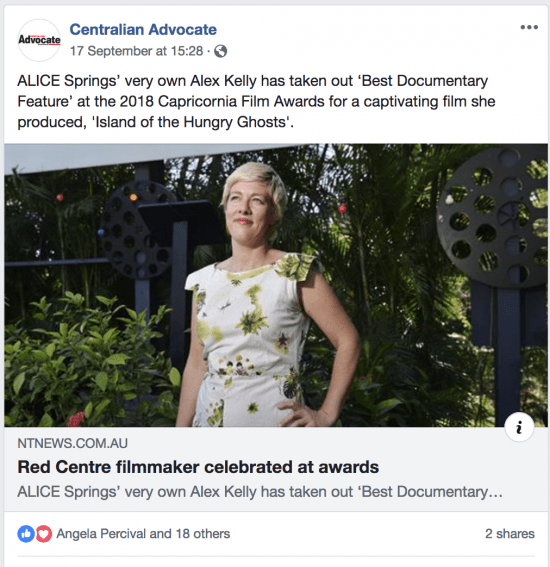
Island of the Hungry Ghosts wins Capricornia Film Award!

https://www.offtheleash.net.au/features/books-film/2018/09/capricornia-film-awards

Screenshot 2018-10-11 12.30.42

Island of the Hungry Ghosts wins Best Documentary at Tribeca!

From the Tribeca Jury:

“The best documentary award goes to a film that demonstrates extraordinary mastery of the full symphonic range of cinematic tools: cinematography, editing, score, sound design and, perhaps greatest of all, an exquisite use of metaphor,” the documentary jury said. “To a film that moved us deeply, impressed us immensely and made us feel we were witnessing nothing less than the emergence, fully formed, of a major new cinematic talent, we are thrilled to award the best documentary award to Island of the Hungry Ghosts.”

See more; https://www.hollywoodreporter.com/news/tribeca-film-festival-2018-award-winners-1106265

Island of the Hungry Ghosts in Tribeca!

Island of the Hungry Ghosts will have its world premiere in Documentary Competition at the 2018 Tribeca Film Festival, New York.

See more on the 2018 program via https://www.tribecafilm.com/stories/2018-tribeca-film-festival-feature-films-guide


Victory for Namatjira family!

Wonderful news from the team at Big hART:

HUGE ANNOUNCEMENT: After 8 years of fighting for justice alongside the Namatjira family, we are absolutely thrilled to announce that the copyright has finally been returned to the Namatjira family. The Namatjira Legacy Trust has entered into a Deed with Legend Press which assigns the copyright in Albert’s works to the Namatjira Legacy Trust, the charitable foundation established to protect and preserve the interests of the Namatjira family and to benefit the Hermannsburg family. This historic resolution is thanks to the support of esteemed law firm Arnold Bloch Leibler who got behind the campaign pro bono, Legend Press and Dick Smith, who stepped forward to negotiate and also provided a donation of $250,000 donation to the Namatjira Legacy Trust. Our huge thanks to you all.

Big hART’s 8 year campaign for justice for the Namatjira family has been supported by many. We’d like to thank Iltja Ntjarra Art CentreBelvoir St Theatre for giving us our first public platform and the Queen for the important recognition she gave to the Namatjira family. We’d like to thank all the institutions, art galleries, partners and funders in Australia and overseas, the cinemas, the film festivals, the journalists who raised their voices in support and all our loyal supporters and community, without this support, the outcome today would not have been possible. #justice4namatjira

See more at;

http://www.abc.net.au/news/2017-10-14/albert-namatjira-copyright-returned-to-family/9050550

http://www.theaustralian.com.au/news/nation/namatjira-landscapes-copyright-breakthrough-opens-way-for-wider-audience/news-story/48b0fade1c16de2b520f178f223a0cd8?nk=d8583337f7b118a483f3422eb8a506d6-1507969662