Those responsible for the climate crisis must be made to pay for the mess they have made.
I am no stranger to heat or fires. I grew up on a farm in Wiradjuri Country, Victoria, and then lived for fifteen years in Arrernte Country in Mparntwe, Central Australia. But the heat and fires I grew up with are nothing like what we are seeing now.
As we drove down the Calder Freeway to Melbourne on Friday, I watched the emergency apps show the fire front moving towards our house and listened to reports of devastating loss to Djaara Country in Harcourt. All I could think about was how much the fossil fuel companies owe us. I did mental calculations of just how much disaster preparedness and cleaning up in the aftermath costs – and not just financially.
Research from Oxfam found that, in 2024, 585 of the world’s largest and most polluting fossil fuel companies made $583 billion in profit. In 2024-25, export earnings from Australian fossil fuel companies were $385 billion. In contrast, the Australian government’s disaster fund is worth just $4.7 billion. Over the weekend Albanese toured Harcourt and announced a $19.5m support package. But the Australian government is still subsidising the fossil fuel industry that is responsible for worsening climate disasters to the tune of $14.9 billion a year.
For decades, fossil fuel companies have dug up coal and gas knowing full well that the carbon emissions that they profit from were heating up the planet. They long suppressed the science on climate change, and are still doing everything they can to prevent the move away from fossil fuels, which is what real action on climate change involves. These fires are not natural – their ferocity is man-made.
To add salt to the wound, the gas industry does not pay its fair share of tax. Instead, our communities are left to crowdfund to cover the cost of rebuilding. My community is so incredible that a snap fundraiser held at Boomtown winery over the weekend raised $130,000. This is because we all want to help, but it shouldn’t be up to us to foot the bill.
How is it just that my friends, my footy captain and my kid’s psychologist be out volunteering to protect our homes, sports fields, schools and cafes from these wildly unpredictable ferocious fire storms when the companies responsible for them are let off the hook?
We are going to need vast resources to manage the ongoing, rolling crises that burning fossil fuels has created. The impacts of heat, drought and flood will become more frequent and the costs will mount. Those responsible for the climate crisis must be made to pay for the mess they have made.
We must get off fossil fuels. We need an immediate ban on all new fossil fuel projects and to invest in substantive planning and funding for a rapid transition for workers and communities currently reliant on these industries. I strongly support calls for a Climate Pollution Levy – a disaster levy – to fund the cost of the training, planning, infrastructure and equipment required to respond to crises of this magnitude as well as the transition. I also want to see actions for compensation as we have seen deployed for asbestos and tobacco companies in the past.
All this is needed so that our SES, firefighters, and local CFAs are properly equipped to deal with the increasing scale and frequency of these disasters. It is also needed to pay for psychologists and trauma counsellors, to pay for emergency food systems and telecommunications services, and better resourced health services. We also need this funding to cover the cost of emergency housing so that people are safe during the immediate aftermath of these crises, as well as during the long tail of recovery. Accessing housing is already a disaster that needs addressing and until then we know that these emergencies will amplify every existing fault line. The resources for these services and equipment must be fairly and equally distributed.
I’m back home, and our house is still standing. The fire front passed about six kilometres away, and it shifted direction with the cool change on Sunday. But, despite the incredible efforts of the CFA, fifty families and over 85 businesses in the nearby town of Harcourt were less lucky. Countless animals and plants have been killed as well as immeasurable damage caused to Dja Dja Wurrung cultural heritage. Over 3,700 hectares of beautiful Djaara Country already burnt and, at the time of writing, the powerful mountain Leanganook is still on fire. As we settle back in, the whirr of helicopters fighting the fire to our east can be heard. I’m trying not to stress my kids.
I know this isn’t the last summer my community will go through this. As we face the ongoing and increasingly devastating impacts of the climate emergency we are going to need to be ready to support each other, year in and year out. I am so humbled by the generosity and ingenuity of my neighbours and friends and our powerfully connected mutual aid networks, but we can’t manage these crises on our own.
The infrastructure we need is going to cost an enormous amount of money. We know exactly which companies have enormous amounts of money, and exactly which ones are responsible for the climate crisis. Now we need to make them pay for the damage they have done.
Alex Kelly is Director of the Economic Media Centre and a filmmaker, based on Dja Dja Wurrung Country where she lives with her family in Castlemaine.
For her last episode of What are you looking at? podcast Pip Stafford talks to Nadia Rafaei, Alex Kelly, and Amy Spiers, asking them: What can art do?
This episode explores how art can contribute to social change in the world. Nadia talks about the importance of exploring political identity through her work, Alex discusses how artists can collaborate with or contribute to social movements, while Amy shares how her work aims to highlight some of Australia’s history of colonial violence. They emphasise that art can help unravel complex topics, tell stories, imagine futures, inspire conversations and act as a resistance tool, challenging ingrained structures and systems of thought.
This episode was produced, edited and hosted by Pip Stafford for Contemporary Art Tasmania. Additional music from Blue Dot Sessions.
2023.01.17 Originally published by Plurality University https://www.plurality-university.org/publications/agora-5-the-things-we-did-next
Diving into 2029: a narrative performance
‘David, let’s take a deep breath together’, says Alex Kelly, climate and social justice artist, to begin this fifth Agora: ‘Time stamp: October the 6th, 2029.’ Without further ado, she and David Pledger, artist, curator and critical thinker, casually start to share their thoughts and experiences about life in this future world. Their discussion weaves through history, politics and culture, taking us a few years forward in time. David talks about his ongoing work with a digital human, explaining how ‘our ability to figure out the human from the digital is harder and harder to grasp’. Digital humans have been replacing artists in Australia because of the huge decrease of artist population, unable to find financial sustainability. The dialogue then takes a vivid political turn (especially in the context of Australia): ‘With the development of the Truth-Telling Commissions, in parallel to the Blackfullas University, I feel that discussions about land, country and colonial history are very alive, they don’t feel as fixed as they felt in the past’, observes Alex. This ‘past’ that she refers to is our 2022 present: it becomes clear that their performance carries out a critical approach regarding our present world.
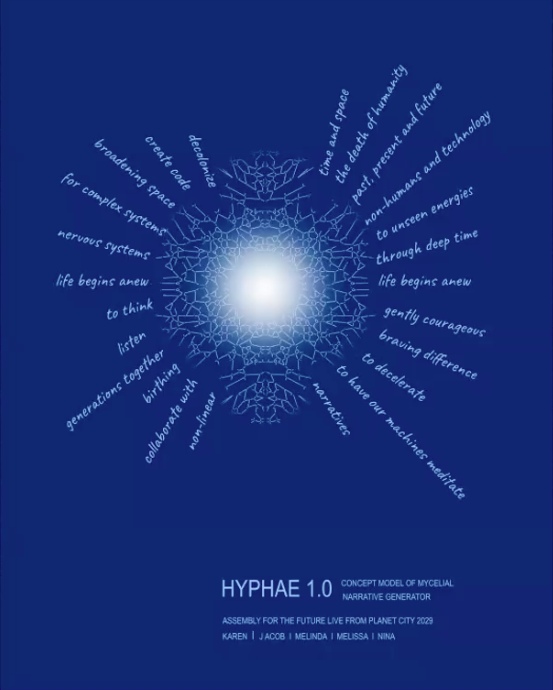
HYPHAE 1.0 Concept Model of Mycelial Narrative Generator: Dispatch by Nina Sellars, generated by Karen, Jacob, Melinda, Melissa and Nina, in response to speculative architect Liam Young’s provocation, who proposed a place called Planet City in which the entire global population moved to one city to let the rest of the planet rewild.
David continues on the subject of colonialism in Australia: ‘The possible dystopian future of an Australian race-based civil war, that some warned us about in the early 2020’s, made us work a lot harder to ensure that that future wasn’t realised.’ Thus, David reminds us of the preventive power of foresighting. ‘Truth-Telling Commission’, ‘Blackfullas University’, ‘Disaster Preparedness Space’… The artists introduce us to new cultural and institutional spaces without describing them any further, letting our imagination project whatever we want into these evocative titles. With a direct but subtle criticism of the liberal system, David relates the caregivers’ strikes that led to a renewal of our modes of relationship: ‘It wasn’t just about care as an economic tool anymore, it became about care as a necessary way of engaging with each other as human beings’. David Pledger and Alex Kelly’s narrative performance goes as far as inventing actual political reforms for the australian society: ‘One of the most interesting and radical things that student strikers did was force the calendar shift of our school years, moving the calendar year to april rather than february in recognition of the hot summer months, and repurposing the school infrastructures as bases of storage and resource use for people’, Alex shares with enthusiasm.
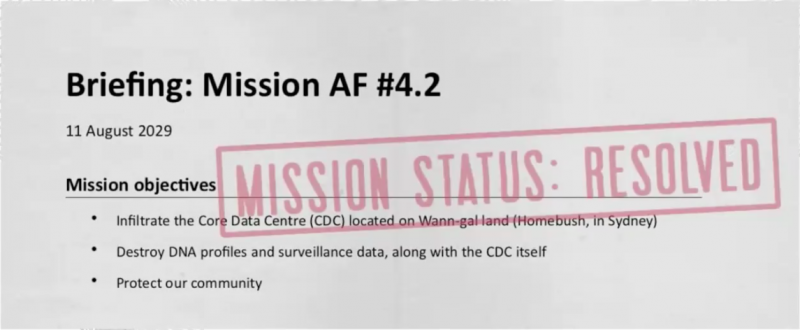
Activist Mission Report AF #4.2: Dispatch from the Third Assembly for the Future, generated by Mali, Jodee, John, Tal, Lara and El, and written by El Gibbs.
After half an hour of dialogue, David ends the discussion on a hopeful note, inviting us to ‘hang in there’ and trust our collective ability to create the changes we want to see in the world: ‘All this seems normal now, when it used to feel like an impossible change at the time’. Like casting a political spell, the two artists project us into a near future in which political mobilisations have led to real changes. The performance’s hidden assumption seems to be: the more you can actually see yourself in a different world – in which what was fearful yesterday has become normal – the easier change becomes.
The original futurists
Welcoming us back to 2022, Alex Kelly reminds us that ‘so-called Australia is made up of over 350 different aboriginal nations’, and specifies that she is located on the Dja Dja Wurrung territory. In doing so, she sets the scene of the highly politically engaged nature of their collective creative practice. Working with first nation collaborators is as important for them as it is instructive, particularly because they have a way of thinking about time very different from our western way, since ‘the apocalypse – British arrival – has already happened for them’. ‘First Nations peoples are the original futurists, we have so much to learn from indigenous futurism’, claims Alex enthusiastically.
After this artistic immersion, it is time to explain the collective creative practice that Alex and David created together, The Things We Did Next. Their website reads: ‘it is a collaborative practice that generates a series of interconnected artworks and projects based on collectively imagining multiple futures’. What we just experienced is one of many methods and art performances that they (and their collaborators) carry out. Alex Kelly relates how one intuition became the seed that brought the project to where it is today: ‘We are not good at imagining other futures because we are reinforced by our dystopian reality (like the global rise of right wing parties). We must become more disciplined at imagining new futures, to change our determinism’. After meeting with the artist David Pledger, they decided to undertake this purpose together, using art to bring people to practise their capacity to see a larger range of possibilities. The goal is not to design one great future, a singular and better destination, but to invent, experiment, and assume the contradictions and the plurality of what our imaginations are capable of creating: ‘the messier, the better’, claims Alex.
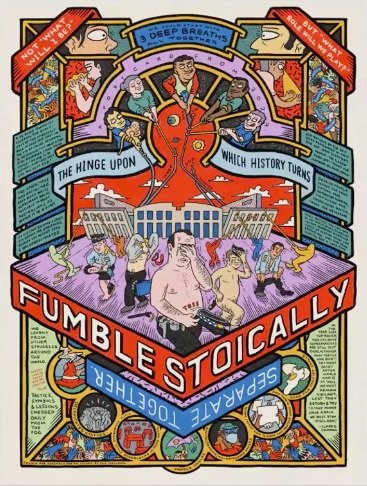
A Postcard from 2029: Dispatch by Sam Wallman from the First Assembly for the Future.
The method
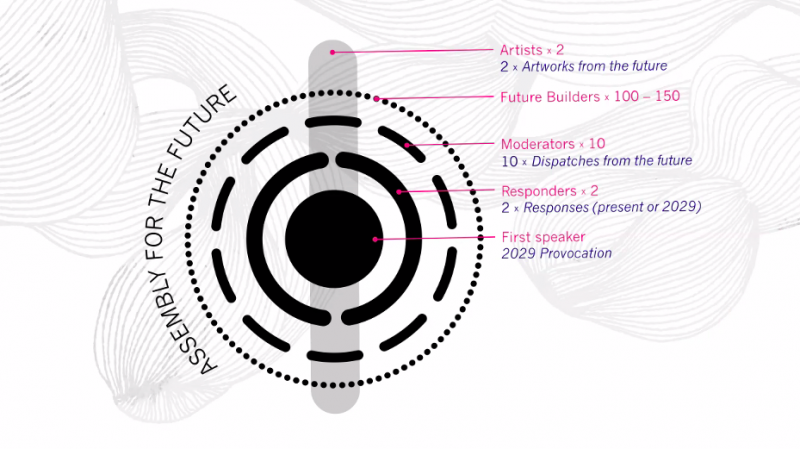
One of the main projects within Alex and David’s practice is what they call the Assembly for the Future, which is a participatory digital workshop of future making. David Pledger explains the dramaturgical strategy of concentric circles used to create disruptive and transversal thinking. The gathering starts with a provocation (resembling the narrative performance they made at the beginning) proposed by an artist: the so-called ‘First speaker’ maps out a future world in 2029. Then, two previously selected respondents improvise a reaction to this call, speaking from the present or the future, thus creating a triangle of discourse. The assembly is then split into 10 groups, moderated by 10 artists who guide the conversations towards embracing collectively a large range of possibilities for the imagination. After one hour of conversation, each artist-moderator delivers a short snapshot of what went on in their group, shortly describing the future that they developed. Artist-moderators are then given a week to generate any form of artwork based on their group’s conversation. In addition, two other artists are invited to observe the Assembly, and are then commissioned to create artworks from the future that inspired them during the Assembly. At the end, the Assembly, generally made up of 150 people – so-called ‘Future Builders’ – produces approximately 2.5 hours of conversations, 1 ‘Provocation’ and 12 artworks called ‘Dispatches from the Future’.
‘The afterlife of the work is tentacular’, claims David. The Dispatches are openly published on the website, leading to various exhibitions, but also the artists themselves reuse what they created. For example, an artist-moderator created a Centre for Reworlding from one of the Dispatches generated during an Assembly for the Future. The participants usually find it useful to attend these assemblies: Alex relates conversations with activists and political organisers who find themselves rethinking their strategies in a less linear way.
The art of embracing the mess
Every aspect of The Things We Did Next’s practice is designed to embrace the mess, i.e. considering imperfections, differences, and trial-and-error as the most interesting and beautiful parts of life: (1) welcoming contradictory narratives, (2) mixing people from different social and cultural backgrounds, (3) and constantly questioning the biases of the methodology.
(1) Welcoming contradictory narratives: The objective is indeed to operate in the space between utopian and dystopian futures, therefore creating narratives with complexity instead of consensual and binary issues. The plurality of the futures created enables them both to be contested, discussed, and to exemplify the democratic nature of our common future. For them, embracing the mess is highly political.
(2) Mixing people from different social and cultural backgrounds: First, because diversity is a condition for the cultural richness of the narratives. Secondly, the careful approach to accessibility – including that of the design methods – reflects the political engagement of the practice’s initiators. For example, they organised an event with the objective of reuniting generations around future making. Regarding accessibility for socially disadvantaged groups, David Pledger explains that it demands specific work in order to create an environment in which ‘they feel that they have the same agency as everyone else’. While they haven’t been focusing on this issue for the Assembly for the Future project – and are conscious that they could ‘do better’ -, they conduct other artistic projects that address it directly. Each Assembly is an occasion to gather participants that reflect the Australian society, so the practitioners ‘target and send information to various social groupings, especially when choosing artists and respondents’.
(3) Constantly questioning the biases of the methodology: The challenging of the process and the method is an important ingredient of this creative collective practice. Alex and David pay a particular attention to the biases that are conveyed through the narratives that they produce. Attending to the biases in the present which can impact the future is a way both of preventing determinism and reducing the practitioners’ blind spots. ‘We cannot control, we are constantly challenged by the numerous artists and collaborators that participate in the conversations: it’s a way for us to attend to the bias that we have’, explains Alex Kelly.
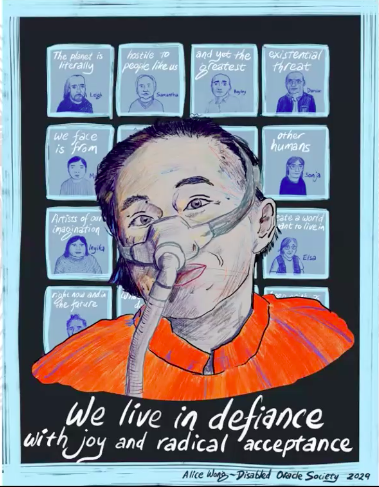
Dispatch by Joshua Santospirito from the Third Assembly for the Future, after Alice Wong’s provocation, The Last Disabled Oracles.
‘Art is a process that cannot be grabbed’
Embracing the mess is also a way of resisting the instrumentalisation of their practice for capitalist means. Art is not used as a tool, but as a method and a process: ‘How do we subvert this idea that art only has a value if it can work as a tool for something?’, asks Alex. She and David are highly conscious of the current neoliberal system through which the value of art has become doing something for the world. David deplores that ‘in Australia, art is often talked about as a commodity, a cultural product, reducing an artwork to a financial unit primarily’. This is due to the fact that ‘neoliberalism shifted from an ideology into an interface, most interactions are now transactions’, continues David. Instead, they decided to think of art as something that is about creating and experimenting processes, conversations and methods. Defining their practice as a process has the advantage of rendering it resistant to the capitalist approach because ‘a process cannot be grabbed, possessed’, claims David. It is all the more important given that ‘the corporate world has an interest in futurist methodologies to support companies and protect capital’, explains Alex Kelly. In opposition to this approach, The Things We Did Next designed a practice whose goal is to ‘enable new discussions around hope, adjustment and possibility, centering care and justice’, as defined in their manifesto. I can’t help but wonder: if a process cannot be grabbed, but can be told, is storytelling just a new way for the neoliberal doctrine to instrumentalise art?
Seen from the outside, the artworks generated by the practice are intriguing but obscure. One thing is certain: you had to be there, and next time I will!
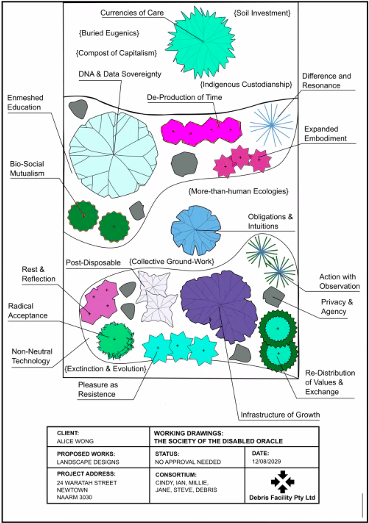
Working Drawings of the Society of the Disabled Oracle: Dispatch from the Third Assembly, from a future generated by Cindy, Ian, Millie, Jane, Steve and Debris.
This online agora took place on October 6, 2022, as part of Narratopia’s Collective Creative Practices project. It was organized by the Plurality University Network (U+), and facilitated by Alex Kelly and David Pledger.
The industries that have fuelled the climate crisis, funded climate denial, and blocked just climate progress for decades must pay for the damage they have caused. Holding them liable means ensuring that they are held criminally and financially responsible, and that they are made to end the practices that have driven this crisis in the first place.
The question of who should pay for the loss and damage of climate change raises familiar problems in distributive justice: Should rich countries pay be¬cause they are richer or because they have emitted more? We can add another: or because they’ve inherited more of the liabilities from global racial empire?
In the last few weeks, like many others, I have sent money to a range of different GoFundMe and Chuffed campaigns for flood impacted communities across NSW and Queensland—for the Aboriginal Community of Lismore, the brilliant Quandamooka artist Megan Cope and infamous counter culture ratbag Chris Lego; as well as dear friends who have lost everything to the mud and water. I refreshed each of the pages regularly, gratified to see them reach their targets quickly.
While it is heart-warming to see how quickly we can get cash into the hands of people who need it right now, it begs the question of who should actually be paying for the recovery.
We know that every La Niña will bring more of these devastating floods and storm cells. We know that in the drier years of El Niño we will be facing increasingly catastrophic bushfires. We are running out of adjectives to convey the scale and ferocity of the disasters we face.
The climate emergency is here—we are living in it.
Initial estimates put the clean-up bill for these floods in the billions. Communities affected by the deadly fires of summer 2019-20 still haven’t seen the resources they need to properly recover; people are still living in tents two years later. We can’t leave communities to fend for themselves in the wake of these destructive events.
The government has a $4.7bn disaster fund. Insurance companies will be paying out by the millions and citizen crowdfunds are going to transfer millions, too. But it shouldn’t be our taxes or our private cash or the insurance firms who foot the bill for this mess. It is those who got us in to this disaster who must pay—the planet-wrecking fossil fuel companies.
As we process the magnitude of these floods, while still trying to make sense of the black summer fires, it is clear that we are going to need significant resources to manage the ongoing, rolling crises that will define our lives in the decades to come. As these impacts become more and more frequent, we need to organise around the idea that those responsible for the climate crisis must pay for the mess they have made.
The polluter pays principle (PPP) is not new. It was embedded in the 1992 Rio Declaration on Environment and Development and has a variety of applications in both binding and non-binding laws, policies and conventions around the world.
This principle is what underpins attempts to place a price or tax on carbon and emissions. Contested as they are, these policies don’t go far enough in taking into account either historic emissions or the colonial context in which they were accelerated.
Both the Emergency Leaders for Climate Action and The Australia Institute call for a $1 per tonne levy on carbon pollution from fossil fuel production to be introduced to raise money for the National Climate Disaster Fund. In May 2021, the Greens introduced the Liability for Climate Change Damage Bill (Make the Polluters Pay). These and all the attempts to put a price on carbon are a necessary beginning, but we need to go further again—not just charging them for the damage they do now, but making them liable for the damage they have already done. We need powerful government intervention, commensurate with the scale of the ever-worsening crises we face.
Social movements can no longer just ask for what we think is politically possible—we have to ask for what is required.
First, we urgently need to get off fossil fuels. To start that transition we need to rule out any further government subsidies to coal, oil or gas extraction, which currently sit at over $12bn a year. We need an immediate ban on all new fossil fuel projects and to invest in substantive planning and funding for a rapid transition for workers and communities currently reliant on these industries. Then we need to raid their coffers and take back the profits they have made trashing our shared home. They must pay for the years of preparedness and ongoing disaster recoveries ahead of us.
There are precedents for this kind of payout. In Australia we have seen successful class actions for those impacted by asbestos. In Canada, a recent decision saw tobacco companies forced to pay $15bn in compensation and punitive damages. Around the world there are lawsuits taking place to hold fossil fuel companies to account, such as a group of cases in the US based on the idea that
the industry severely aggravated the environmental crisis with a decades-long campaign of lies and deceit to suppress warnings from their own scientists about the impact of fossil fuels on the climate and dupe the Americanpublic.
On this continent, we must understand the gigantic wealth of the fossil fuels companies in the context of invasion. The idea of addressing historic injustice and the ways in which the colonial project has fuelled the climate crisis is increasingly being understood as Climate Reparations. Olúfẹ́mi O. Táíwò explains that the ‘historical connections between the climate crisis and our present systems of injustice help explain why a just future depends on reparations.’ Approaching the polluter pays principles with a justice lens takes in to account the colonial debt owed on this continent and can be seen as an important extension of growing calls and commitments to Pay the Rent in this settler colony.
We need to develop regulatory mechanisms that reflect the specific histories of theft—of labour and of land—that enabled so much wealth to be accrued. We need to set up mechanisms to distribute that wealth that are reparatory and that are embedded in and informed by truth telling and Treaty processes.
I spent the peak days of the floods scrolling, in awe as people set up ingenious shared Googledocs, watching in real time as people scoured social media for rescue alerts and relayed information and addresses to people out in boats. Following the organising lead by the Koori Mail and many other across the Northern Rivers and the Bandjalung community. Amazing. And yet—how is it that we are at this stage of the climate crisis without significant investment, crisis and preparedness training across the continent? Why are communities cobbling together shared excel spreadsheets to find old people in roof cavities?
Impacted communities will always be the first responders and there are more neighbourhood groups and mutual aid networks being established across the continent every time we face another crisis—be it the pandemic or a flood, drought or a cut-off highway. Why is the establishment of such groups being left to local community volunteers? Where is the national coordination supporting this grassroots planning and preparation and connecting these efforts to other emergency services?
We need to resource training, planning, infrastructure and equipment. We need to fund our SES and firefighters, our local CFAs. We need psychologists and trauma counsellors. We need emergency food systems and mobile emergency telecommunications services. We need better resourced health services. We need emergency housing for the immediate aftermath of the crisis and in the long tail of recovery. And we need the resources for these services and equipment to be fairly and equally distributed.
We are going to need all of this and more year in and year out as we face the ongoing and increasingly devastating impacts of the climate emergency. It is going to cost an enormous amount of money.
We know exactly which companies have enormous amounts of money. It is those that are responsible for global heating and those that have done everything to suppress the science and undermine climate action. We know that all profit on this continent comes from stolen land, stolen labour and much of this has been supercharged by the extractive industries.
Now we need to make them pay for the damage they have done.
First published in Screen Hub https://www.screenhub.com.au/news/news/filmmakers-we-need-to-talk-about-andrew-forrests-new-film-fund-1477507/
With many thanks to everyone who I discussed this piece with in putting it together.
Filmmakers, Andrew Forrest has arrived – we need to talk about the ethics of his new film fund.
This conversation can never start from a position of absolute moral purity – particularly on this continent where so much wealth is derived from invasion and extraction. I’m not commentating without having made compromises myself; I’ve consulted on projects funded by fossil fuel money and others backed by profits from the pharmaceutical sector. If perfection were a prerequisite for taking a political position none of us could move. The very fact that the resource sector’s money is everywhere – in our cancer institutes, across the arts, backing our sporting teams and building our public institutions – demonstrates the stronghold these companies have and the ways in which they are working to safeguard their social license.
Now a new player is entering the film space and we need to think deeply about what this means for us.
Andrew Forrest is the second richest person in Australia (after Gina Rinehart). His net worth is around $27 billion dollars. He just bought himself an island for $42 million. Now his philanthropic Minderoo Foundation wants to support social impact films. We need to examine this fund – its agendas, potential influences and where the wealth comes from.
Forrest’s track record is public and concerning. From his concerted attempts to divide communities to undermine the native title of the Yindjibarndi people to further his Fortescue Mineral Group’s pursuit of iron ore, to his backing of the cashless welfare card the list of Forrest’s controversies is long. This month he is in the news for pushing back on national laws to protect Indigenous cultural heritage.
This conversation is necessary. We need to reflect on what such a powerful funder means for filmmakers, particularly for those of us that strive to expose injustice and contribute to making impact with our films.
According to Forrest, Minderoo’s new film fund’s purpose is to ‘motivate people, companies and governments to act … reassess their behaviours or start a movement‘.
With Forrest’s immense wealth behind them and an initial budget of at least $10 million, this foundation has the capacity to powerfully shape the funding and content landscape for filmmaking in Australia and around the world. But what do they mean when they talk about social impact films?
Impact Producing is a relatively new term, coined by Doc Society (formerly BRITDOC) in 2011. In the past ten years, the social impact film sector has exploded in terms of content produced, definitions of terms, understanding of best practice, industry credibility and investment in this kind of film work. Good Pitch Australia really put the practice on the map locally, brokering considerable philanthropic funding and backing films such as Frackman, The HuntingGround and That Sugar Film. The core aspirations of this kind of film work are to make transformative change, using the medium of film to promote and enact social justice. In a short space of time, impact filmmakers have worked intensely to define the terms of our practice and set the standards for the work we do.
The work of social justice films can be highly impactful. The need for more funding is clear.
But what happens to the sector when a highly influential new funder rides into town? What kind of films will Minderoo Foundation fund? Would they fund a climate change documentary whose social impact strategy campaigned for a mining tax, billionaire wealth cap or land rights? Are they even qualified to speak about impact?
Understanding and doing the work of impact is complex. Definitions of social change and social justice are always contested. Corporate and neoliberal influence often pushes us to measure success through limited lenses; bums on seats and social media conversions are easier to measure than behavioural and cultural change.
Despite deeper conversations around filmmaking ethics, culturally safe practices and questions regarding representation and power finally getting more attention there is a long way to go to achieving justice in the filmmaking space. The thinking around social impact in film is still very young. This work is fragile and often slow, requiring critical conversations about power and control. It is hard to see how Forrest’s foundation is equipped for this kind of work and it is worrying to think about them erasing or simplifying the important work that is happening to develop best practice in the social impact film practice.
When learning of the film fund Michael Woodley, CEO of the Yindjibarndi Aboriginal Corporation (YAC), who has stood up to FMG over many years said the Minderoo Foundation ‘has no moral standing in relation to social impact’. (The thirteen-year battle Woodley led against Forrest is detailed in Paul Cleary’s new book Title Fight – not sure we’ll see a Minderoo-backed adaptation of that social impact story anytime soon).
Minderoo’s arrival on the scene is a big financial deal, which is probably why it has been met with only favourable media so far. The $10M they are proposing to invest initially is almost as much as the lead government film agency Screen Australia invests in documentaries each year. For context; Screen West invested just over $3M in documentary production in 2019/2020, Screen Australia invested just under $13.5M on documentary in 2020/21 while Good Pitch Australia raised some $12M from numerous funders for 18 films over three years.
The $10M they are proposing to invest initially is almost as much as the lead government film agency Screen Australia invests in documentaries each year.
Of course, there is not enough money to do this work well. Nor may there be any funding source that is absolutely clean or free of compromise (however there must be lines that we draw somewhere – would we take money from tobacco companies, weapons manufacturers or Adani?) The lack of resources to do our work and the messiness of funding ethics shouldn’t mean we let the announcement of this new film funding pass without critique – in fact these sticky questions should propel us to engage more deeply with these dilemmas.
There are profound social and ethical questions around the wealth that Forrest has generated and how. He should consider paying reparations to the communities from which he has extracted his wealth before he starts trying to shape policy through philanthropy. Or perhaps Andrew Forrest’s companies could just pay their taxes. That would be a more democratic distribution of Forrest’s wealth, rather than vesting decision making about philanthropic beneficiaries in a select few appointed by Forrest.
Sponsorship of arts and culture by large corporations, particularly those in the fossil fuels and resource sector, has been described as ‘artwash’ by British writer Mel Evans. Artwashing is the process by which large companies clean up their dirty image through a public-relations approach mediated by cultural philanthropy. This brings us to the question of social license. Making a documentary film can be a long hard slog. Do filmmakers, especially those working for social justice, really want to do all the hard work and then and badge that work with a company with such a tarnished track record? How can we make impact films with integrity if they are backed by money derived from problematic sources?
Finally, there is the question of influence: of which films get made and how Minderoo’s work may shape the social impact sector itself, in terms of how ideas of social change are upheld and discussed. Films that are funded by Minderoo will be more likely to get funding and tax offsets via the government film agencies than those without an investor on board. Such a big player can have significant influence on what kinds of films get made and on where public funding goes. Of further concern is the fact that Minderoo have made it clear they will take an active editorial role in the films it funds.
In an already strained funding environment, the risk of the weight and influence of a large corporate player is too great to ignore. Private sector money isn’t subject to an arms-length peer review process. It is money with its own agenda, and Forrest’s track record indicates that this agenda could put the entire social impact film sector’s credibility at risk.
As filmmakers, directors, producers and curators we should be deeply concerned about the impact this kind of funding could have on our industry.
We need to do more than just talk about it. We should refuse to accept Forrest’s money.
In her book Arts Wash: Big Oil and the Arts, British writer and Liberate Tate organiser Mel Evans defines artwashing as the process by which large oil companies clean up their dirty image through a public-relations approach mediated by cultural philanthropy. Artwashing is an extension of the notion of greenwashing, where companies feign green credentials to build credibility for their brand and generate social capital. Evans asks:
How is it that there is a gap between all these harmful impacts that oil companies like BP have through their daily activities around the world and our acceptance of them as part of our lives? A big part of what happens in that gap is artwash – the way in which oil companies project a better image of themselves to the public through their associations with cultural institutions and sport and their social license to operate.
Artists and the arts sector need to take a hard look at the kind of social license we are granting the fossil fuel industry and weigh that up with our contract with the audiences and communities we serve.
There are significant parallels here to the ways in which tobacco advertising was once commonplace and is now seen as unacceptable. Activists, doctors and campaigners worked to ensure stricter controls of tobacco advertising as the public health impacts became clear. The health impacts of the climate emergency are vast and are set to impact everyone on the planet—far beyond the damage tobacco has caused—so of course the same advertising standards should apply to fossil fuel companies.
In their 2019 project Maps of Gratitude, Cones of Silence and Lumps of Coal, arts collective The Centre for Everything mapped the web of relationships between the fossil fuel sector and the arts in so-called Australia. The web is so busy that the diagram the artists created to map the links between organisations, boards, directors, festivals and funding has little blank space and is a mass of lines, nodes and connections.
As she walks us through the map in the video that accompanies the project, Gabrielle de Vietri—who is now the Mayor of the City of Yarra—asks:
What about the impact on the arts? It’s not just about money. These associations to people and brands inform the culture of our institutions. From the way the workplace operates to which artists are supported. They can influence who tells a story and influence our shared culture. Are we still willing to accept their money and their governance and in exchange grant them, the fossil fuels industry, their social license to operate?
Darwin Festival, one of the largest festivals in the Northern Territory (NT), takes place in the tropical dry season. It hosts some incredible work from First Nations artists from across the Territory and opens with a free concert featuring First Nations artists from across the continent, an event which is sponsored by oil and gas producer, Santos. 51 per cent of the land of the Territory is under active exploration licenses for gas fracking; Santos is a major permit holder and one of the most advanced in these explorations.
The relationship between Darwin Festival and Santos is emblematic of art-washing in the Australian arts context, and is particularly devastating in a First Nations cultural context. As well as accruing social capital, the Santos money silences communities by putting First Nations artists in a position where they have to choose between backing campaigns in their communities opposed to fracking and staying quiet to take up the opportunity to perform in the largest creative showcase in the Territory.
The forced relationship between First Nations artists and the fossil fuel sector brokered by the festival is particularly exploitative when so many historical and contemporary examples of fossil fuel extraction occur on First Nations lands and in proximity to communities, deeply impacting traditional culture and dividing communities over its impacts, risks and limited monetary reward.
There has been a consistent campaign by Territory artists, audiences and arts sector organisations since 2015—when the first open letter was published—calling on Darwin Festival to break ties with gas companies. The campaign has included securing commitments to replace fossil fuel producers with ethical sources of philanthropic funding to ensure that artists and audiences don’t miss out if fossil fuel ties are cut. So far, Festival organisers and their corporate and government backers have yet to respond to these offers, and have even increased fossil fuel sponsorship in recent years bringing Japanese oil and gas company Inpex into the mix.
Further south, in Western Australia, climate activists had a victory earlier this year, when they managed to get the Perth Fringe to terminate its sponsorship by Woodside Petroleum. The campaign lobbied for the event to break ties with the company, and in June they celebrated when it was announced that Woodside would no longer have naming rights. Barely a few weeks passed before Woodside and Artrage, the event’s producer, announced a new philanthropic partnership.
The Western Australia arts and cultural sector are inextricably linked with the extractive industries. The Guardian reports that there ’it is impossible for arts companies to completely wean themselves off sponsorship from the fossil fuels sector.’ Author Mark Naglazas continues:
Woodside is also a sponsor of Barking Gecko Theatre, Yirra Yaakin, the WA Symphony Orchestra and WA Ballet. Fortescue Metals Group supports Black Swan Theatre Company; BHP is the principal partner of Awesome Arts; Chevron has the naming rights for Perth festival’s music strand (also targeted by activists); Tianqi Lithium is the naming sponsors of a gallery of the new WA museum Boola Bardip; and Rio Tinto is the premium partner of CinefestOZ.
The underlying value of these sponsorships is that they ‘offset’ the low levels of tax paid by fossil fuel companies compared to their profit base. In truth, if they did pay adequate taxes, there would be significantly more money available to governments to support the arts—and health, and education. These companies are not being altruistic: they are paying a minimal amount of money in sponsorships (in terms of their wealth) whilst casting themselves as good, corporate citizens and building a culture of dependency and silence around a polluting and culturally destructive industry.
So, what can artists do when we are so squeezed financially and struggling to survive the conditions created by Covid-19, particularly ongoing cancellations of our work?
A practical way to reject fossil fuel funding has been developed by Groundwater Arts, a US citizen-artist collaborative. They propose a clause that artists can insert in their contracts to reject funding derived from the extractive industries. It reads in part:
Client/Employer [should define ‘Client’ and ‘Employer’ in the contract] hereby represents and warrants that: (i) it has not heretofore knowingly and willingly received funds or donation from fossil fuel industries.
Artists can advocate for the inclusion of similar clauses in Australia’s workplace agreements developed by our peak arts organisations such as NAVA, Theatre Network Australia, APAM and MEAA. Festivals, arts organisations and artists can actively engage in securing relationships with funders investing in climate action and climate justice whilst simultaneously and publicly withdrawing their support—and their hard-won social capital—from the art-washing initiatives of the extractive capitalist industry. We live in a time in which there is no alternative.
In concluding the Maps of Gratitude film, Gabrielle de Vietri sums it up best:
The social context of our arts must become more authentically connected to our ethics. To the tides of public sentiment. To the urgency of our times. We must interrupt the cultural soliloquy of big business and replace it with the urgent and overwhelming public outcry demanding climate justice.
Mamunya – the Friends of Nalderun – are launching a crowdfunding campaign to purchase culturally significant land back for the Nalderun Aboriginal community of Castlemaine, and to protect Me-Mandook Galk – (which translates conceptually as) the beautiful grandmother tree.d
My people’s lives were dramatically interrupted at the time at the time of European settlement. It is now time to reconnect to this land. For the Aboriginal community to repurpose this land .. for Culture and to reconnect to Country is a small ask. A small ask would give future generations purpose and a way to connect to their Culture and to reconnect to mother earth to din din to this, this land. Your contribution could have huge impacts in this change. – Uncle Rick Nelson
We encourage you to give generously – this is a truly remarkable opportunity to ensure Aboriginal Land is in Aboriginal hands and we believe it will be a powerful step for this community.
Nalderun needs to raise $150,000 to purchase the site – please dig deep and help spread the work.
Please spread the word – you can share posts from instagram and facebook – whatever you can do to share the campaign far and wide would be amazing!
CRITICʼS PICK
In My Blood It Runsʼ Review: ʻI Want to Be an Aborigineʼ
In plain vérité style, the documentary follows an Arrernte Aboriginal family in Alice Springs, Australia.
By Teo Bugbee
Published June 11, 2020
Colonialism is a war that began hundreds of years ago and never ended. Its modern tactics and its weapons are noted
with precision in the ferocious documentary, “In My Blood It Runs.”
The film follows an Arrernte Aboriginal family in Alice Springs, Australia, focusing on Dujuan, a 10-year-old boy, and his mother Megan, as they navigate his education. In plain vérité style, the documentary exposes how language and
school are corrupted to become bludgeons for the system built by settlers.
At home, Dujuan is a gifted healer who speaks three languages, and he is a gentle comfort to his mother. But at
school, his teachers are white, and they mock Aboriginal spiritual beliefs while teaching a whitewashed version of
colonial history. Dujuan is disengaged and angry, and his grades, attendance and behavior suffer. Megan’s fear is that Dujuan could be taken from her and placed in juvenile detention, and as Dujuan’s aunt warns him, if he goes to
detention, he’ll either leave it for jail or a coffin.
The director Maya Newell gains access to both worlds that Dujuan traverses — home and school — and the trust that
she seems to have built with all participants is vital to the success of this film. In both settings, her subjects rarely acknowledge the camera directly. She captures natural behavior, whether she observes care or cruelty. Voices rarely raise, but the film still vibrates with fury.
In the final minutes, Dujuan is given an opportunity to express what would satisfy him, which he does in language
simple enough that even his teachers should be able to understand:
“Leave black kids alone.”
“Stop killing Aboriginal people.”
“I want to be an Aborigine.”
Episode #27 – COVID-19 has shaken the foundations of life as we know it. There is fear, but is there hope as well? This episode features three stories, about healthcare, mutual aid and green stimulus, that show people making something better out of this difficult time.
We speak with Dr. Claire Hooker, from Sydney Health Ethics at the University of Sydney; Professor David Isaacs, one of Australia’s leading infectious disease doctors; Dr. Robert Kennedy, a G.P in Redfern, inner city Sydney; Alex Kelly, a strategic communications consultant and an instigator of a mutual aid group; Elly Bird, a councillor from the Lismore area, active in social groups that assist vulnerable communties; and Dr. Daniel Aldana Cohen, a sociology professor at the University of Pennsylvania and co-author of the book Planet to Win: Why we need a Green New Deal.
Listen by clicking play above, or listen via an app on Apple, PodcastOne, Spotify or Stitcher – or on most other podcast apps by searching “ChangeMakers.”